
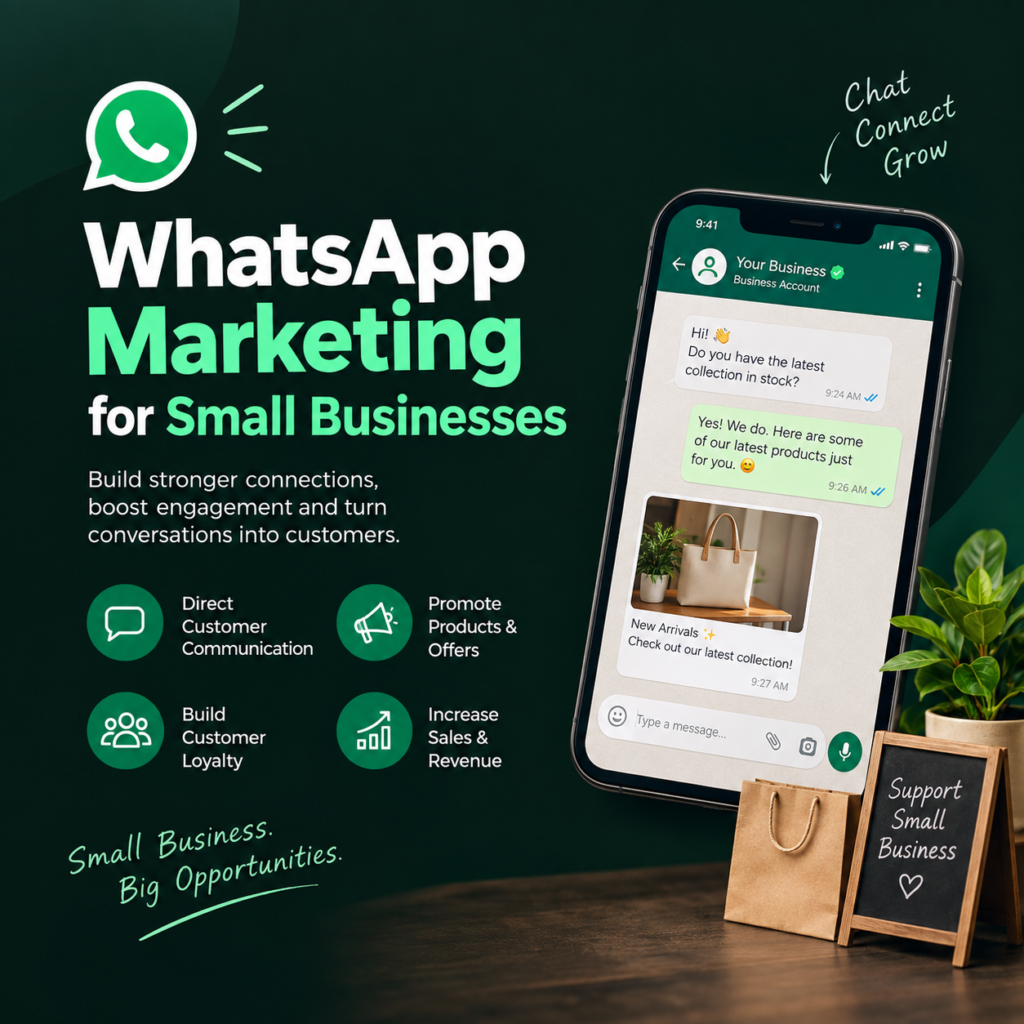
WhatsApp has become an important communication channel for businesses that want to connect directly with customers. For small businesses, it can be especially useful because it combines messaging, customer service, relationship building, product discovery, and sales in one familiar platform.
Unlike traditional advertising, WhatsApp allows businesses to have direct conversations with customers. A customer can ask a question, request a price, make an appointment, receive an update, or complete a purchase without having to navigate through multiple channels.
For small businesses with limited marketing budgets, this direct connection can be a major advantage.
In this beginner’s guide, we’ll explain what WhatsApp marketing is, why it matters, how to get started, what types of content you can send, and how to turn WhatsApp conversations into real business opportunities.
What Is WhatsApp Marketing?
WhatsApp marketing is the use of WhatsApp to communicate with customers and promote products or services.
Businesses can use WhatsApp for many purposes, including:
- Customer support
- Product promotion
- Sales conversations
- Appointment booking
- Order updates
- Offers and promotions
- Product recommendations
- Customer feedback
- Lead generation
- Business announcements
Instead of relying only on public social media posts, businesses can use WhatsApp to communicate more directly with people who have chosen to interact with them.
The key is to provide useful and relevant communication rather than sending unwanted promotional messages.
Why WhatsApp Marketing Is Important for Small Businesses
Small businesses often face challenges such as limited advertising budgets, low brand awareness, and difficulty maintaining customer relationships.
WhatsApp can help solve some of these challenges by providing a direct communication channel.
1. Direct Customer Communication
Customers can contact a business directly instead of filling out complicated forms or waiting for email responses.
A simple message such as:
“Hi, I want to know the price of this product.”
can start a sales conversation.
2. Faster Responses
Customers increasingly expect quick responses.
WhatsApp allows businesses to answer questions, provide information, and solve basic problems quickly.
3. Relationship Building
People are more likely to buy from businesses they trust.
Regularly providing useful information, answering questions, and helping customers can strengthen relationships.
4. Cost-Effective Marketing
Compared with some traditional advertising methods, WhatsApp can provide a relatively affordable way to communicate with an existing customer base.
The real value, however, comes from using it strategically rather than simply sending large numbers of messages.
WhatsApp Business vs Regular WhatsApp
Small businesses should generally consider using WhatsApp Business rather than relying on a personal WhatsApp account.
WhatsApp Business provides features designed specifically for businesses, including business profiles and tools for managing customer conversations.
A business profile can include information such as:
- Business name
- Category
- Description
- Address
- Website
- Business hours
These details help customers understand who they are communicating with.
For larger or more complex businesses, WhatsApp also offers business solutions designed for communication at greater scale.
How to Create a WhatsApp Marketing Strategy
Creating an account is easy.
Creating a strategy is more important.
Before sending messages, decide what you want WhatsApp to accomplish.
Your goals could include:
- Getting more leads
- Increasing sales
- Improving customer service
- Promoting new products
- Increasing repeat purchases
- Booking appointments
- Building customer loyalty
Choose one or two primary goals initially.
For example, a beauty salon might use WhatsApp primarily for appointment bookings and customer reminders.
An online store might use it for product recommendations and customer support.
1. Define Your Target Audience
You need to understand who you are communicating with.

Think about:
- Age
- Location
- Interests
- Buying habits
- Common problems
- Preferred products
- Frequently asked questions
For example, a local bakery may have customers looking for birthday cakes, wedding cakes, custom desserts, and same-day orders.
Understanding these needs allows the business to send more relevant messages.
2. Build a Permission-Based Contact List
One of the most important rules of WhatsApp marketing is to communicate with people appropriately and respect their preferences.
Don’t simply collect phone numbers and start sending promotional messages.
Instead, encourage customers to voluntarily provide permission to receive relevant updates.
You can invite customers to connect through:
- Your website
- Social media
- In-store signage
- QR codes
- Checkout
- Business cards
- Events
- Customer service interactions
For example:
“Message us on WhatsApp to receive product updates and special offers.”
Make the purpose clear so customers understand what they are signing up for.
3. Create a Professional Business Profile
Your profile should make your business look trustworthy.
Include:
Business name:
Use your actual business name.
Description:
Clearly explain what you sell or what service you provide.
Business hours:
Tell customers when they can expect a response.
Website:
Add your website or online store if you have one.
Location:
Useful for local businesses.
A professional profile reduces confusion and creates a stronger first impression.
4. Use a Clear Welcome Message
When a customer contacts your business for the first time, a helpful welcome message can make the conversation easier.
For example:
“Hi! Welcome to ABC Bakery. Thanks for contacting us. How can we help you today? You can ask about cakes, prices, custom orders, or delivery.”
The message should be short and useful.
Avoid making the welcome message feel like a long advertisement.
5. Use Quick Replies
Small businesses often receive the same questions repeatedly.
Examples include:
- What are your prices?
- Where are you located?
- What are your opening hours?
- Do you deliver?
- How long does delivery take?
- How can I book?
- What payment methods do you accept?
Create prepared responses for common questions so your team can respond quickly while still keeping the conversation personal.
6. Create Useful WhatsApp Content
WhatsApp marketing shouldn’t be limited to promotional messages.
Create content that provides value.
You can send:
Product Updates
Tell customers about new products or services.
Special Offers
Share relevant discounts or promotions.
Helpful Tips
A skincare business could share skincare advice.
A fitness business could share simple workout tips.
A financial service could share basic financial education.
Behind-the-Scenes Content
Show how products are created or how your team works.
Customer Stories
Share testimonials or customer experiences, with appropriate permission.
Important Announcements
Notify customers about holidays, opening hours, events, or service changes.
7. Use WhatsApp Status
WhatsApp Status can work similarly to Stories on other social platforms.
It can be useful for showing frequent updates without sending a direct message to every customer.
Businesses can use Status for:
- New products
- Daily offers
- Limited availability
- Customer reviews
- Behind-the-scenes videos
- Educational tips
- Business announcements
- Short videos
For example, a restaurant could post its daily special on WhatsApp Status.
A clothing store could show new arrivals.
A salon could showcase recent work.
8. Use WhatsApp Catalogs
For businesses selling products, a catalog can make it easier for customers to browse available items.
A product listing can include information such as:
- Product name
- Description
- Price
- Image
- Relevant details
Instead of sending multiple product photos individually, businesses can direct customers to their catalog.
This can make the buying process simpler.
9. Turn Conversations Into Sales
WhatsApp is particularly useful because customers can ask questions before buying.
Suppose someone sees a product on Instagram and sends a WhatsApp message.
Instead of immediately saying:
“Buy now.”
the business can ask:
“What are you looking for?”
Then the business can recommend the most suitable product.
This creates a consultative sales process.
For service businesses, the same principle applies.
A digital marketing agency might ask about a customer’s business, goals, and current marketing challenges before recommending a service.
The goal is to solve the customer’s problem rather than simply push a product.
10. Use WhatsApp for Customer Support
Marketing doesn’t stop after a customer makes a purchase.
Customer support can have a major impact on loyalty.
Businesses can use WhatsApp to help with:
- Order questions
- Delivery updates
- Product information
- Booking changes
- Basic troubleshooting
- Feedback
- Complaints
A good support experience can turn a first-time buyer into a repeat customer.
11. Personalize Your Messages
Nobody wants to receive irrelevant advertisements.
Instead of sending the same message to everyone, divide your audience into meaningful groups.
For example:
- New customers
- Existing customers
- Repeat customers
- Customers interested in a specific product
- Customers who haven’t purchased recently
- Local customers
Then create messages that are relevant to each group.
A customer who recently purchased running shoes may be interested in running accessories.
A customer who recently booked a salon appointment may be interested in a follow-up service.
Personalization makes communication more useful.
12. Don’t Send Too Many Messages
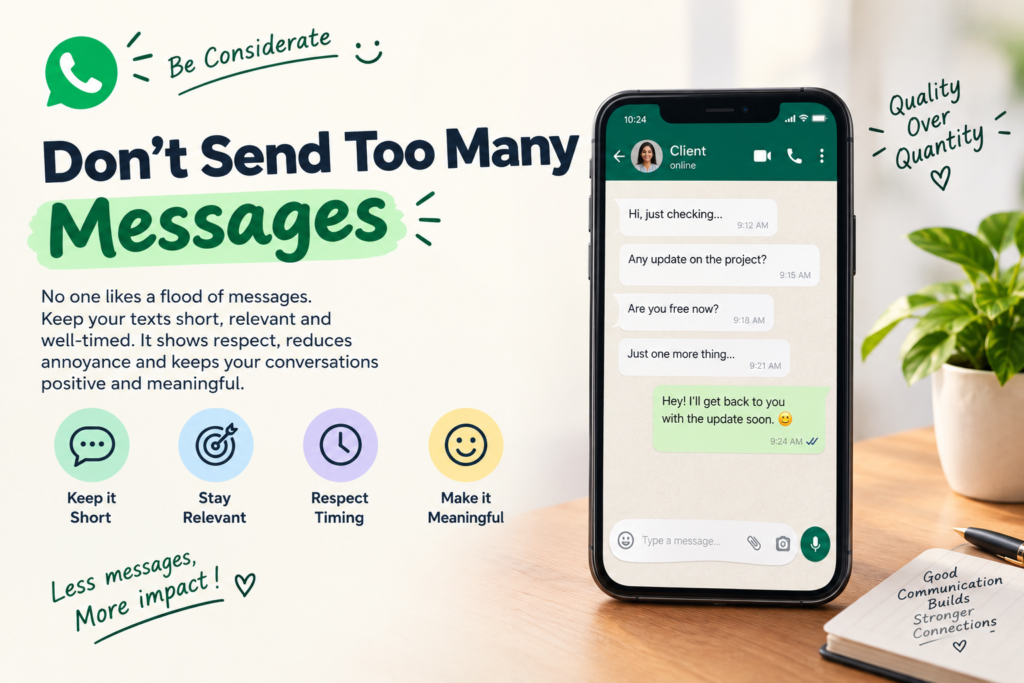
One of the fastest ways to lose customer trust is to send excessive promotional messages.
Before sending a message, ask:
“Does this provide real value to the customer?”
If the answer is no, reconsider sending it.
Give customers control over their communication preferences and respect requests to stop receiving marketing messages.
Quality is more important than quantity.
13. Combine WhatsApp With Social Media Marketing
WhatsApp works especially well when combined with other digital marketing channels.
For example:
Instagram → WhatsApp → Conversation → Purchase
You can use Instagram to attract attention and WhatsApp to handle questions and sales.
Similarly:
Google Search → Website → WhatsApp → Lead
This creates a connected customer journey.
For example, a local service business could place a WhatsApp contact option on its website so visitors can quickly ask questions.
14. Use WhatsApp Links and QR Codes
Make it easy for customers to start a conversation.
You can place WhatsApp contact options on:
- Websites
- Social media profiles
- Digital advertisements
- Business cards
- Posters
- Store displays
- Product packaging
QR codes can also be useful for physical businesses.
A restaurant, for example, could display a QR code that allows customers to contact the business for reservations or information.
15. Measure Your Results
Marketing decisions should be based on results rather than assumptions.
Depending on your setup, monitor metrics such as:
- Number of conversations
- Leads generated
- Response time
- Customer inquiries
- Sales
- Repeat purchases
- Conversion rate
- Customer feedback
For example, if 100 people contact your business through WhatsApp and 20 become customers, your conversation-to-customer conversion rate would be 20%.
Tracking these numbers helps you understand whether your strategy is actually contributing to business growth.
Common WhatsApp Marketing Mistakes
Sending Unwanted Messages
Always respect customer preferences and applicable messaging rules.
Making Every Message Promotional
Balance promotions with useful information.
Taking Too Long to Respond
Slow responses can cause potential customers to choose competitors.
Using a Personal Account for Everything
A dedicated business setup can provide better organization and professionalism.
Writing Very Long Messages
Keep marketing messages clear and easy to scan.
Ignoring Customer Questions
Every conversation can be an opportunity to build trust.
Focusing Only on Sales
Long-term customer relationships are more valuable than one-time transactions.
Example WhatsApp Marketing Strategy for a Small Business
Imagine you own a local clothing store.
Your strategy could look like this:
Monday: Share new arrivals on WhatsApp Status.
Tuesday: Send an educational styling tip to customers who have opted in to receive updates.
Wednesday: Share a customer review.
Thursday: Publish a short product video.
Friday: Promote a weekend offer to a relevant customer segment.
Saturday: Answer customer questions and help with product selection.
Sunday: Share behind-the-scenes content or upcoming product information.
This approach keeps communication varied and useful instead of turning WhatsApp into a constant advertising channel.
The Future of WhatsApp Marketing
WhatsApp marketing is likely to become increasingly connected with broader digital commerce.
Businesses can use messaging as part of the customer journey from discovery to purchase and support.
AI and automation can also help businesses handle repetitive customer questions, organize conversations, and provide faster responses. However, businesses should maintain human oversight and make sure automated communication remains accurate, transparent, and useful.
The businesses that succeed will not necessarily be those that send the most messages.
They will be the businesses that provide the right message, to the right customer, at the right time.
Conclusion
WhatsApp marketing gives small businesses a direct way to communicate with customers, build relationships, answer questions, promote products, and generate sales.
The most effective strategy isn’t about sending as many promotional messages as possible. It’s about building trust and making communication useful.
Start by creating a professional WhatsApp Business profile, defining your target audience, building a permission-based contact list, and creating helpful content. Use Status, catalogs, quick replies, personalized communication, and customer support to improve the experience.
Then measure your results and improve your strategy over time.
Remember:
Don’t use WhatsApp simply to sell. Use WhatsApp to help, communicate, build trust, and make buying easier.
When customers see your business as helpful rather than intrusive, WhatsApp can become a powerful part of your overall digital marketing strategy.